
Too busy to come to the phone
Before the word is spoken it has already elapsed, the goodbye preceding itself, echoing forward into a future that folds back and names it origin, and the line — if it is a line, if it is not instead a loop or a thinning membrane — trembles with voices that are less voices than permissions denied in advance, the mother’s speech arriving already concluded, Sylvia is busy, meaning Sylvia has been removed from the field in which I might still occur, meaning the present is an afterimage and I am speaking into what remains once the speaking has failed.
Forty cents more for the … next … three … minutes … please — no, not currency but duration quantified, time shaved into payable increments — and the operator’s tone, unowned, without body or memory, inserts itself between pulses of thought, counting not minutes but possibilities foreclosed, and I reach — not outward but backward, inward, across a seam that refuses to stay open — saying please, Mrs. Avery, in a voice that has not yet become mine or has already ceased to be, asking for a while that cannot exist because the interval has already been spent elsewhere, in another ordering of events where the answer was given before the question cohered.
She is trying, the mother says, but trying is indistinguishable from having tried, from having completed the act in some parallel tense that bleeds into this one, and the new life is not beginning but begun, not ahead but surrounding, enclosing, so that every attempt to enter it becomes a confirmation of exclusion, and Galveston — down Galveston way — whether place or merely a word dense enough to displace me — expands and contracts like a lung I no longer share, breathing a future that has no space for recall.
The line continues — does it continue, or do I persist within it, mistaken for continuity — and the phrases repeat, not repetition but recursion, each iteration slightly altered by the knowledge it contains of its own failure, Sylvia’s happy, so why don’t you leave her alone, the sentence closing around itself, a loop that tightens with every pass until it is no longer directive but condition, the world arranged so that leaving is the only verb left that still refers to me.
Coins fall or do not fall; the mechanism accepts or refuses; the distinction dissolves, because what is purchased is not time but the illusion of adjacency, and I bargain with the structure of the moment as though it were negotiable, as though saying I only want to tell her goodbye could compress the divergence into something crossable, but the word goodbye fractures under its own anticipation, each syllable arriving out of sequence, good — already past, bye — not yet permitted, the whole never assembling in a single, stable now.
Packing, leaving, marrying — these do not occur in order but simultaneously, a cluster of completions that radiate backward, rewriting the cause that might have led to them, and the train departs before it is named, the nine o’clock existing as both schedule and aftermath, and the rain begins in every tense at once, falling on what has not yet happened, soaking what is already gone, the umbrella raised over an absence I cannot occupy.
Thank you for calling, the voice says, gratitude misplaced in a system that cannot receive it, and won’t you call back again becomes less invitation than recursion’s promise, that the scene will reinstantiate, that I will re-enter this thinning corridor and attempt again what has no entry point, and the operator — constant, immortal, at the tone the time will be (hour), (minutes) and (seconds) — marks the boundary once more, asking for more not because more is possible but because the asking is what defines the limit. Followed by a short beep.
That quick her umbrella caught up over her arm she runs out of the mirror like a cloud, her veil swirling in long glints her heels brittle and fast clutching her dress onto her shoulder with her other hand, running on out of the mirror the smells roses roses roses roses the voice that breathed o’er Eden. Then she was across the porch I couldn’t hear her heels then in the moonlight like a cloud, the floating shadow of the veil across the grass, into the bellowing. She ran out of her dress, clutching her bridal, running into the bellowing where T.P. in the dew Whooey Sassprilluh Benjy under the box bellowing …
And so the goodbye, never singular, never complete, proliferates, a series of near-utterances latticed with yellow slashes full of dust motes blown inward from the scaling blinds that overlap and cancel, tell her — tell — her — good — bye — each fragment sliding along the wire’s surface without crossing, until even the fragments lose distinction and become a continuous interior resonance, not sound but the memory of sound displaced from time, and I remain — not here, not there, but in the interval that cannot stabilize — listening to what has already finished happening, waiting for the moment before it began.
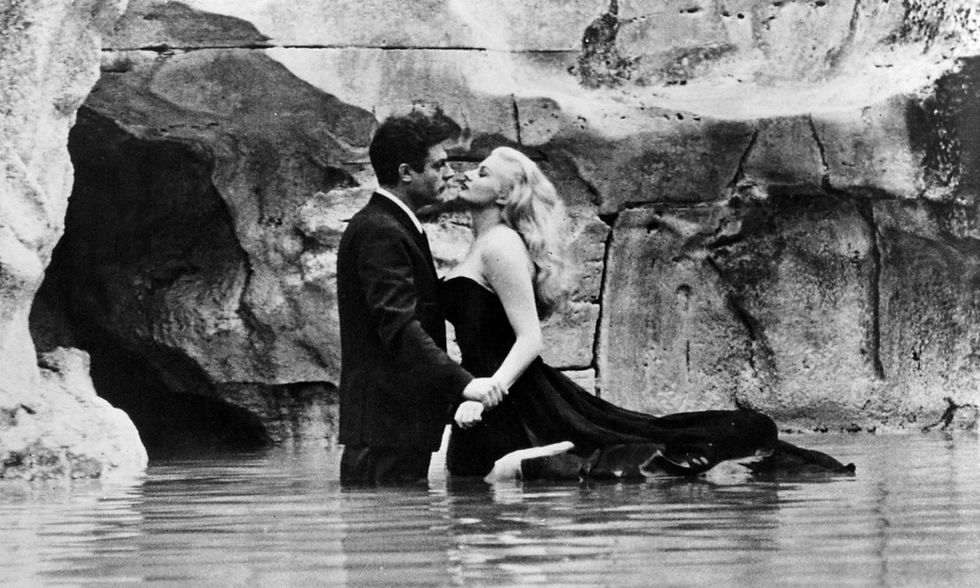
You just wake up, and kiss the good life, goodbye…